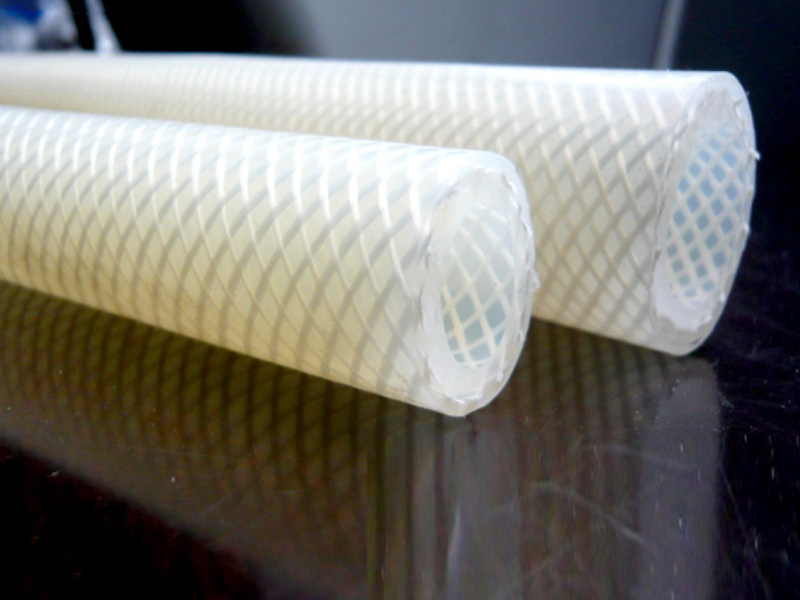
Pressure resistance requirements for woven silicone tubing used in coffee machines
Time:2023-01-12Page views:2770Coffee machines can save time in brewing coffee. The brewing process of the equipment is carried out under high temperature and pressure, and silicone, as a high-temperature resistant material, needs to meet the requirements of food grade and pressure resistance before installation and use. At present, the general compression requirement for coffee machines is 30-40KG. Coffee machines useWoven silicone tubingThis is because ordinary silicone tubes have low anti explosion pressure, and silicone tubes without weaving technology cannot meet the pressure resistance requirements.
The woven silicone tube can transfer the pressure resistance inside the coffee machine to the woven fabric, which is woven in a mesh structure to further distribute the pressure to other woven fabrics. To prevent breakage under high pressure impact, a layer of silicone tubing is usually added outside the fabric. The pressure can be circulated through three stages: silicone, woven fabric, and outer silicone, so that each surface can withstand the pressure evenly, but there is also an upper limit, and the burst pressure cannot exceed 45kg.
The woven silicone tube needs to meet FDA food grade standards and withstand the high-pressure environment during coffee machine operation. Therefore, manufacturers use high transparency and quality silicone materials when extruding to solve the problem from the source. In addition, secondary vulcanization on the original basis can slightly increase the upper limit of burst pressure. Usually, after secondary vulcanization, the original burst pressure of about 30-35 kg is increased to ≥ 38 kg. After weaving, the silicone is vulcanized again, and the entire silicone braided tube will shrink and fit tightly, so that each compression point will be more uniform and less likely to break.
The pressure bearing capacity of woven silicone tubes is stronger than other silicone tubes because of the weaving process, which results in a higher explosive pressure per square meter than other silicone tubes. The diameter of the silicone tube also affects its pressure resistance. The smaller the size and thicker the wall thickness of the tube, the higher the pressure it can withstand.